
How forensic art gives restores faces, names and dignity back to the forgotten
By Tinotenda Chiyangwa
I am Tinotenda Chiyangwa, the first Zimbabwean forensic artist and 3rd in the African continent.
DISCOVERING MY PURPOSE
From an early age, I was captivated by crime and forensic science programs, particularly the process of identifying individuals from skeletal remains. Although I was naturally drawn to scientific inquiry, I also devoted significant time to developing my natural artistic abilities. Throughout my life, I experienced a persistent tension between these two interests, often questioning whether I was destined to pursue art or science.
In my mid-twenties, I discovered forensic art and immediately felt I had found my calling. While studying Forensic Art and Facial Imaging at the University of Dundee (UK), I felt a strong sense of belonging. For the first time, I saw how my artistic skills could contribute meaningfully to society. More importantly, I had found a space and profession where art and science work together rather than existing separately. Today, being a forensic artist is significant to my professional and personal identity.
WHAT IS FORENSIC ART
Forensic art is the application of artistic techniques including drawing, digital illustrations and image modifications to support legal investigations. The discipline encompasses various facets, including:
-
Craniofacial reconstructions
-
Composite sketching
-
Age progression
-
Post-mortem depictions
-
Forensic photography
-
Crime scene photography
-
Crime scene reconstruction
Fundamentally, forensic art is essential for restoring and preserving human identity.
RESTORING IDENTITY TO THE MISSING
Identity is a human right, and every individual is entitled to possess one.
Forensic art supports the restoration of identity through multiple methodologies. Identification of individuals from skeletal remains can be achieved using craniofacial approximations, while facial comparisons assist in locating missing and trafficked persons. Additionally, composite sketches generated from witness recollections aid in identifying criminal suspects. Although these techniques can be highly effective, their reliability increases when combined with other identification methods, such as DNA analysis, thus enhancing the likelihood of achieving a positive identification.
RECONSTRUCTING FACES FROM THE PAST
Forensic art also allows us to rediscover identities that have disappeared through history. Working alongside forensic anthropologists and archaeologists, forensic artists can produce scientifically informed approximations of the appearances of individuals who existed centuries ago. Artefacts recovered from burial sites and surrounding areas; skeletal analysis and archaeological evidence help reconstruct not only facial appearance but aspects of everyday life.
One such project involved the facial reconstruction from skeletal remains discovered in 1932 in Penhalonga, Zimbabwe, now housed within the Raymond A. Dart Collection of Archaeological Humans Remains at the University of Witwatersrand (Johannesburg, South Africa).
Figure 1
The Penhalonga skull used for facial reconstruction
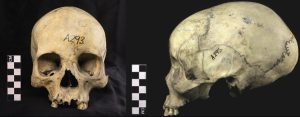
Skull as retrieved from Steyn and Meyer (2020)
The facial reconstruction done was based on images and osteological assessments presented in Assessment of human skeletal remains from the Penhalonga district, Zimbabwe (Steyn & Meyer, 2020).
Osteological analysis from sternal rib ends suggested the remains most likely belonged to a female between the ages of 25 to 46years. However, the pubic symphyses suggested an age estimation between 26-70years. Considering the available evidence, a median age range of 40-49years was selected for the reconstruction.
The reconstruction was conducted in two dimensions using Adobe Photoshop 2024, employing varying craniofacial reconstruction methods, including regression equations developed by Guyomarc’h and Stephan (2012). Soft tissue depth markers were first applied to estimate the thickness of the tissue at different craniofacial landmarks, which enabled a drawing of the overall facial shape. Estimations of facial proportions such as eye position, nasal dimensions, lip thickness and ear placements were employed.
Figure 2
Application of soft tissue depth markers.
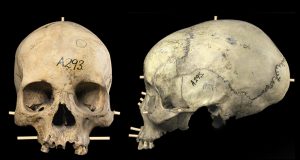
Figure 2 – Skull with soft tissue depth markers
Radiocarbon dating placed the remains between cal.AD 1228–1396. The exceptional preservation of the remains made this project particularly exciting, offering a rare opportunity to visualize the face of a Zimbabwean woman who lived centuries ago which may not always be possible.
To support my reconstruction, I conducted some research through online archival records and consulted traditional leaders whose oral histories provided invaluable insight into the lifestyles, customs and way of life of communities during this period. The construction represents a combination of visual refences from online archives of colonial-era photographs and cultural remembrance.
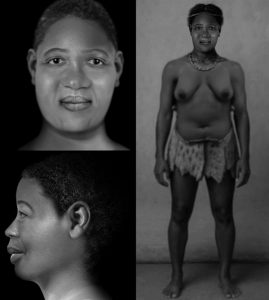
Figure 3-6 [Completed facial reconstruction and artistic interpretation incorporating traditional attire]
Figure 3. Anterior view of facial reconstruction
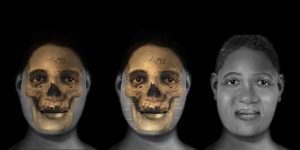
Figure 4. Lateral view of facial reconstruction
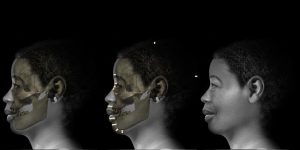
Figure 5. Anterior facial reconstruction
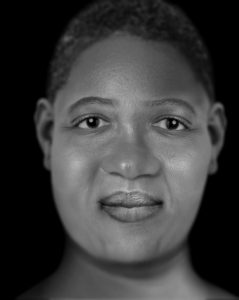
The forensic art techniques employed throughout this project enabled the creation of a scientifically informed facial representation from skeletal remains, which restored the identity and humanity to an individual who lived several centuries ago. Understanding who our ancestors were help us better understand ourselves.
Figure 6. An artistic reconstruction showing possible traditional wear
PATRICIA: Training the Next Generation
For my dissertation project, I developed a highly realistic forensic training model designed to help practitioners acquire practical skills in crime-scene and post-mortem photography, both essential for the identification of deceased individuals. Affectionately known as ‘Patricia’, the manikin was constructed using a 3D-printed PVC mould and silicone gel. To make it appear more realistic, it was painted using a mixture of silicone paints and silicone gel, and synthetic hair was individually implanted.
Figures 7 – 8 show the details of the manikin.

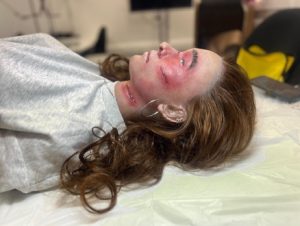
Figure 7 and 8 – lateral view of manikin
The project’s primary aim was to provide a realistic and accessible training resource for forensic practitioners and students to practice photographing deceased individuals in different scenarios. This is especially important in an academic setting as access to human cadavers, especially for photography training purposes is often very limited or restricted. Alternatives are therefore imperative. Patricia has several unique identifying markers, including tattoos, facial moles and piercings, enabling students to also practice identifying and photographing unique identifying markers.
Figure 9 shows the tattoo used as a unique identifying marker.
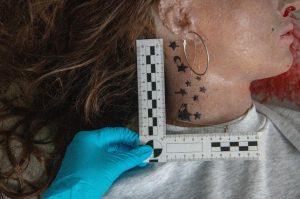
Figure 9 – manikin tattoo
Additionally, the model enables students to practice creating postmortem depictions; the process of editing and manipulating images designed to make deceased individuals more recognisable while remaining appropriate for public appeals seeking identification. Below is an example of a possible post-mortem depiction done using Patricia.
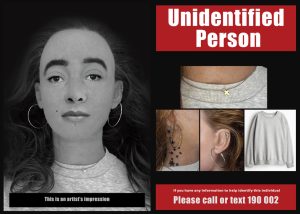
Figure 10 – Example post-mortem depiction done using Patricia
HELPING WITNESSES REMEMBER
Forensic art extends beyond identifying the deceased.
One important application involves helping law enforcement identify criminal suspects through witness testimonies which is achieved through cognitive interviews. This is a technique in which forensic artists work alongside witnesses to create composite images based on the details of the witness’s memory call.
Forensic artists are trained to use various interviewing techniques that help memory recall while maintaining a supportive, relaxed and non-leading environment to increase the likelihood of positively identifying the perpetrator.
Because human memory can be susceptible to distortion, witness recollections can be influenced by experiences, media exposure and even discussions with other witnesses about the events. Recognising that witnesses are often distressed, I developed an educational comic book introducing people to the cognitive interview process, help reduce anxiety and feel better prepared before an interview begins. The comic shows the general structure of a cognitive interview, the type of questions to expect as well as the type of memory revival exercises and techniques that they may perform.
Rather than depicting human faces, the comic features animal faces/characters to reduce the risk of interfering with the witnesses’ memory recall. Showing human faces before an interview may unintentionally shift their focus to the faces they have recently seen as opposed to the faces we are trying to get them to recall. Animal illustrations also make the material suitable for children who have witnessed traumatic events.
Fig. 11-12 Images showing the character designs of the comic.

Figure 11 – Comic cover and sample pages

Figure 12 – Pages of the cognitive comic
THE FUTURE OF FORENSIC ART IN AFRICA
Everyone deserves to have their identity respected.
Forensic art restores identities and upholds human dignity. It helps families locate missing relatives, recover loved ones’ remains, identify perpetrators, and achieve justice for victims. It also deepens our understanding of the present by connecting us to our ancestors and ourselves.
Across Africa, I am proud to be part of a growing community of dedicated forensic artists.
Among those leading the field are Dr Kathryn Smith, Pearl Mamathuba, and Dr Elysia Greenway. Through VIZ LAB, founded by Dr Kathryn, unites visual arts, the humanities, and forensic science, and other collaborative efforts, they promote interdisciplinary approaches to forensic research and practice. Their work advances humanitarian investigations, human identification, and justice.
It has been an honour to learn from these remarkable women and witness their dedication to advancing forensic art across Africa.
As the first Zimbabwean forensic artist and the third in Africa, I am privileged to contribute to this growing movement. I remain optimistic about the future of forensic art on the continent.